
Midterms test Trump’s political power
Clip: 10/30/2026 | 10m 1sVideo has Closed Captions
Midterms test Trump’s political power
Key battleground races are close in the lead-up to Election Day, and the results could upend the balance of power in Washington.
Problems playing video? | Closed Captioning Feedback
Problems playing video? | Closed Captioning Feedback
Major funding for “Washington Week with The Atlantic” is provided by Consumer Cellular, Otsuka, Kaiser Permanente, the Yuen Foundation, and the Corporation for Public Broadcasting.
Midterms test Trump’s political power
Clip: 10/30/2026 | 10m 1sVideo has Closed Captions
Key battleground races are close in the lead-up to Election Day, and the results could upend the balance of power in Washington.
Problems playing video? | Closed Captioning Feedback
Where to Watch Washington Week with The Atlantic
Washington Week with The Atlantic is available to stream on pbs.org and the PBS app.
Buy Now
10 big stories Washington Week covered
Washington Week came on the air February 23, 1967. In the 50 years that followed, we covered a lot of history-making events. Read up on 10 of the biggest stories Washington Week covered in its first 50 years.Providing Support for PBS.org
Learn Moreabout PBS online sponsorshipVivian Salama: Good evening and welcome to Washington Week.
I'm Vivian Salama, in tonight for Jeffrey Goldberg.
Tuesday's midterms will determine how much room Donald Trump has to govern in his final two years in office, and the results are anything but settled.
More than 43 million people have already cast a ballot, key races are still razor-tight, and controversy is swirling in, of all places, Alaska.
Meanwhile, President Trump's on, off, and on again red state rallies in these final days highlight a White House on edge.
We have an outstanding panel to make sense of what's next, Peter Baker's chief White House correspondent for The New York Times, Carrie Dann is managing editor of the Cook Political Report with Amy Walter, Susan Glasser is a staff writer with the New Yorker, And Asma Khalid co-hosts the Global Story podcast for the BBC.
Thank you so much for joining me.
Carrie Dann, Managing Director, The Cook Political Report With Amy Walter: Well, I would say, Vivian, that two races that I'm really looking at because I think it'll tell the story of the Senate battlegrounds overall, are Iowa and Kansas.
These are two states that both went for Donald Trump by double digits, Iowa by 13, Kansas by 16.
These are both heavily agricultural states.
They kind of look the same in some ways politically, just if you look at the numbers.
But I think Republicans feel very good about their candidate in Iowa, Ashley Hinson.
They think if anybody in one of these toss-up races is going to pull it out, it's going to be her.
And I think Democrats feel really good about their candidate, Adam Hamilton, in Kansas.
Kansas is a more Republican state on paper.
But I can imagine a scenario in which the Republican wins in Iowa and loses in Kansas, and the real difference is that candidate quality.
Roger Marshall in Kansas had not taken this race very seriously to start with.
I think he's been caught napping a little bit with Adam Hamilton being a great candidate for Democrats in a state like that.
And even though there is sort of this similar agricultural focus, Hinson has been addressing it head on.
She's been distancing herself a little bit from the president.
Roger Marshall has not been doing that.
And I think it tells the story of how the candidates will matter in these races in a way that maybe the math, if you're just looking at past results on paper, may make it look like all of these races are going to go in one direction or the other.
They may be a little bit more idiosyncratic than that.
Vivian Salama: We're looking at seven Senate toss-up races this year.
I mean, that's pretty extraordinary.
How did we even get there?
Carrie Dann: Well, if you had told me that we were going to be looking at a toss-up race in Kansas a year ago, I would've thought I had been hit on the head by something.
Because what you're seeing is these races coming online, the president's approval rating has just plummeted, even in states that he won by double digits.
And voters, I think, in these places are connecting the dots between high prices to tariffs and to the Iran war, and that has been driving down Donald Trump's approval rating and driving down candidates with him.
In regular midterms, candidates in midterms normally distance themselves from an unpopular president.
Because of the nature of the way that Donald Trump interacts with the members of his party, most of them have felt like they can't do that, and I think they're poised to maybe pay a price.
Vivian Salama: Peter, midterm races are always a struggle for the president's party.
That has historically been the case.
But just based on the electoral map, the way the president has been traveling just in the last month alone, in fact, we have an extraordinary m- map to show, 27 rallies in mostly red states in just the last 30 days.
Peter Baker, Chief White House Correspondent, The New York Times: Yes.
Vivian Salama: So, what are the key issues that President Trump is now stumping for, and how much of this is turning into a referendum just about him?
Peter Baker: Yes, it's extraordinary.
So, I was in Chillicothe, Ohio this week with the president.
It's his third time in Ohio this fall.
You look at that map you're showing up there, basically every place he's going is a red state except for New York, every, at least a state he won two years ago.
They're -- he's not playing in any swing states.
He's playing only on comfortable territory or territory they have to have.
Vivian Salama: I mean, we're talking Mississippi, you know?
Peter Baker: We're talking Mississippi, exactly.
Cindy Hyde-Smith, I don't know if she's going to lose.
I think she'll probably be fine.
But, you know, if you're taking the president to Mississippi, you're not in good shape if you're a Republican, right, Kansas and Iowa being the obvious examples of.
But the message I heard on Wednesday from the president is very jumbled because he brags everything is great.
People don't want to hear that.
That's not what people are feeling in their own lives.
And we heard that the last president who tried to convince them that the economy was better than it was, and Joe Biden paid a price for that, too.
They don't want to listen to a politician tell them things are good if they don't feel that they're good.
And the rest of the message I felt on Wednesday that I heard was basically, we love America.
The other side doesn't.
And that was about it.
There wasn't a lot of policy.
There wasn't a lot of like here's what we're going to do to make your lives better.
It was, I love America.
We love America.
The other side doesn't.
Vivian Salama: Asma, you're really seeing a lot of pushback in these final days in terms of messaging what Democrats want the voters to focus on, what Republicans obviously are trying to pitch President Trump out there telling everyone everything's fine.
So, what are the closing arguments of this specific -- specifically of each party, and what's getting through to people?
Asma Khalid, Co-Host Of The Global Story Podcast, BBC News: Yes, and I will say that is largely President Trump's closing message is that things are fine.
I mean, a portion of his closing message, I would also argue, is leaning really heavy into anti-Muslim sentiment.
You hear this from Republicans who are not and to be clear, I think it's directed at the Democratic Senate candidate in Michigan, Abdul El-Sayed.
But what I think is perplexing is that you are hearing this from candidates who are not in Michigan.
You'll hear it from Ted Cruz.
You'll hear it from -- Peter Baker: In Ohio, you would've thought they were in Michigan.
Every single candidate brought up El-Sayed, absolutely.
Vivian Salama: Vice President Vance had been very fixated on him.
Asma Khalid: Yes, and so that seems to be part of the closing message.
And, look, I mean, I will say that the president believes, and maybe this is because of his 2016 run, that juicing up his base, part of that is linked to some of this anti-Muslim sentiment.
And we do know that negative partisanship can be a motivating factor.
And so I do think that's part of the equation that Republicans have, is that maybe they can juice their base in some of those key races, Michigan I suppose in particular.
On the Democratic side, I would say that there's a whole lot of messages I've been actually hearing, too.
And I would argue that's because they think there's a lot of weaknesses in this Trump administration, affordability, affordability, affordability.
But I was also out covering the race.
I was out in Georgia this past week.
I was struck by how much of Ossoff's stump speech is also about not just corruption, but specifically linking the Iran war to the cost.
You don't generally hear loads about foreign policy in a midterm cycle, but he did.
I mean, he just chronologically laid out statements where the president had declared victory and said, you know, on day four, he said this.
On day, you know, whatever it was, 27, and now here we are at, what is it, day 200 and however many days we are in the Iran war.
And that emphasis on trying to connect foreign policy decisions to what is happening here at home, whether it's gas prices or other cost of living frustrations that voters have.
Vivian Salama: Susan, Asma just mentioned Abdul El-Sayed, the Democratic Senate candidate in Michigan.
He's had a pretty surprising uphill battle for -- especially if in a race that's largely favoring Democrats.
You wrote about President Obama hitting the trail this week.
You know, how much juice does he still have among voters?
I mean, he's been out of office for what now?
I'm trying to count, ten years.
And yet they still really covet him being on the trail.
So, how did that play out?
Susan Glasser, Staff Writer, The New Yorker: Yes.
Well, look, I mean, just to President Obama, we all know, right, he is you know, one of the most effective political communicators of our lifetime, and he seems to relish the fight still with Donald Trump.
You know, there's a strong argument to make that his line about Donald Trump this week involving Saddam Hussein and the Cheesecake Factory was sort of an act of, you know, pure genius.
But to Asma's point, what Obama is doing, and I think what some of the more successful Democratic candidates are doing right now, is making a straight line between this is what Donald Trump cares about.
Donald Trump is literally doing, as Obama put it, arts and crafts in the Oval Office, sticking up gold medallions on the wall, focusing on the Reflecting Pool, on building an arch or whatever he's focusing on, as opposed to focusing on the things that Americans care about.
And in a moment when the economy has hit home for so many Americans, there is this direct link between very specific choices that are laid right at the foot of Donald Trump, right?
You know, he started the war in Iran without asking Congress, without really making the case to the American people.
He claimed it would be over.
It wasn't.
There's a sort of a promises made, promises broken aspect to the campaign as well, which I think is why we're seeing, to me, the most surprising aspect of this, not that Democrats would come out in droves, right?
I mean, they're the motivated party out of power.
That's our history.
This election, though, in many respects, is coming down to Republicans, Republicans who believed Donald Trump when he said he was the president of no new wars, who believed Donald Trump when he said that the prices were going to come down on day one of his administration.
And so -- Vivian Salama: Even his immigration message has struggled.
Susan Glasser: Absolutely, because a lot of Republicans, you hear them saying, I didn't vote for this, you know, I didn't vote for my neighbors to be, you know, taken away.
I voted for some evil criminals, you know?
I voted to close the border.
I didn't vote for this.
And, you know, we talked about another race we haven't brought up yet, which is in Texas, the Texas Senate race.
Another remarkable thing, in addition to Kansas, Democrats have not elected a senator from Texas since 1988, Lloyd Bentsen.
If they do so with James Talarico, it will be because of the turnout in South Texas, a largely Hispanic border region of Texas, where many of those voters voted for Donald Trump in 2024.
And all signs point to them not only abandoning Trump's party this year, but actually helping Democrats win something that would've been unthinkable.
Now, we'll see, right?
The votes are not counted yet.
But I think it's an election where we're going to be talking about Republican voters who are no longer comfortable with Trump's version of the Republican Party.
 New
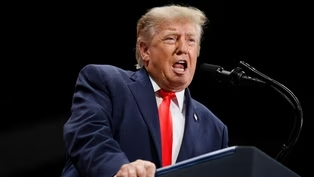
Trump's fraud claims and the fight over election rules
Video has Closed Captions
Trump's fraud claims and the fight over election rules (13m 19s)
Providing Support for PBS.org
Learn Moreabout PBS online sponsorship New Episode
- News and Public Affairs

Top journalists deliver compelling original analysis of the hour's headlines.

- News and Public Affairs

FRONTLINE is investigative journalism that questions, explains and changes our world.

 New Episode
 New Episode
 New Episode
 New Episode

 New Episode
 New Episode

 New Episode


Support for PBS provided by:
Major funding for “Washington Week with The Atlantic” is provided by Consumer Cellular, Otsuka, Kaiser Permanente, the Yuen Foundation, and the Corporation for Public Broadcasting.