
Spice Road | You’ve Never Had Indian Food Like This| S2 E2
Special | 16m 49sVideo has Closed Captions
Kerala cuisine might be India’s best-kept secret—and most Americans have never tried it.
Rupak Ginn checks out Thattu, a Chicago restaurant dedicated to this bold, coconut-rich cuisine from southern India, with writer Jyoti Chand. He also visits Cafe Nova, a Sri Lankan spot with a powerful immigrant story, and Sukhadia’s, a 6th-generation Indian sweet shop that's keeping tradition alive.
Problems playing video? | Closed Captioning Feedback
Problems playing video? | Closed Captioning Feedback
Spice Road | You’ve Never Had Indian Food Like This| S2 E2
Special | 16m 49sVideo has Closed Captions
Rupak Ginn checks out Thattu, a Chicago restaurant dedicated to this bold, coconut-rich cuisine from southern India, with writer Jyoti Chand. He also visits Cafe Nova, a Sri Lankan spot with a powerful immigrant story, and Sukhadia’s, a 6th-generation Indian sweet shop that's keeping tradition alive.
Problems playing video? | Closed Captioning Feedback
Where to Watch Independent Lens
Independent Lens is available to stream on pbs.org and the PBS app.
Aesthetics and Unraveling the AI Hype
Ghost in the Machine seeks to unravel the AI hype to find the untold origins of “artificial intelligence.”Providing Support for PBS.org
Learn Moreabout PBS online sponsorshipMore from This Collection
Films exploring the people, culture, and traditions of food.
Spice Road | What Indians REALLY Eat for Breakfast | S2 E7
Video has Closed Captions
Forget toast and cereal—this is how India does breakfast. (4m 37s)
Spice Road | Can She Identify Indian Bread Blindfolded? | S2 E6
Video has Closed Captions
Can you tell naan from chapati from puri… without seeing them? (4m 56s)
Spice Road | Which Butter Chicken Wins? | S2 E5
Video has Closed Captions
Which store-bought butter chicken is actually the best? (4m 19s)
Spice Road | What Happens When Indian Spices Meet Mexican Classics? | S2 E4
Video has Closed Captions
Try scrumptious Indian-Mexican dishes as South Asian flavors become more popular in America. (6m 25s)
Spice Road | This Bangladeshi Pizza Joint Was Ranked One of the Best in America | S2 E3
Video has Closed Captions
One of the best pizzas in America, according to The New York Times. (15m 12s)
Spice Road | Inside Chicago's First Michelin-Starred Indian Restaurant | S2 E1
Video has Closed Captions
What does it take for an Indian restaurant to earn a Michelin star—for the first time in Chicago? (16m 44s)
The Grocery List Show | Latino Grocery Store in Brooklyn | Ep 5
Video has Closed Captions
A food blogger cooks up his family's garnachas recipe after a jaunt to a Latin American grocery. (12m 21s)
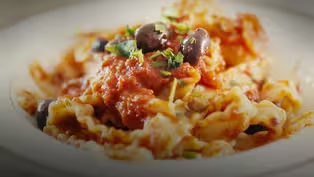
The Grocery List Show | Family-Run Italian Market in New Jersey | Ep 4
Video has Closed Captions
A family-run grocery in New Jersey brings people from all over for delectable treats from Italy. (10m 31s)
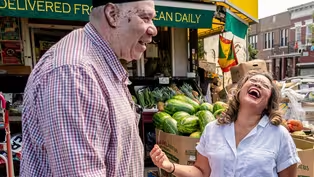
The Grocery List Show | A Little Caribbean Market in Brooklyn | Ep 3
Video has Closed Captions
At a Caribbean grocery in Brooklyn, the "island vibe" infuses the spirit of the neighborhood. (10m 31s)
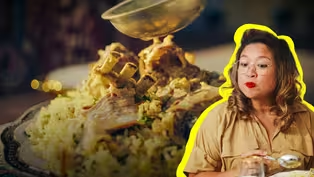
The Grocery List Show | Halal Grocery in Brooklyn | Ep 2
Video has Closed Captions
The family behind a Middle Eastern Brooklyn grocery makes a hearty mansaf meal. (12m 7s)
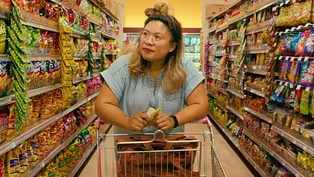
The Grocery List Show | Seafood City in Chicago | Ep 1
Video has Closed Captions
Filipino food galore at Seafood City in Chicago is followed by the making of a crab torta feast. (12m 39s)
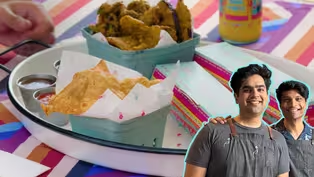
LA Street Food, South Asian Style | Spice Road, Episode 4
Video has Closed Captions
Rupak Ginna goes home to LA for Desi street delicacies and grocery store comfort food. (16m 31s)
Providing Support for PBS.org
Learn Moreabout PBS online sponsorship- I'm in Chicago, the heartbeat of South Asian culture in the Midwest.
Today, I'm gonna crisscross the city using food as a portal to journey to far-flung parts of South Asia.
I'm visiting three celebrated local restaurants to discover how they're building powerful connections across continents through their mind-blowing food.
This is "Spice Road."
Let's go.
(bell dings) My gustatory exploration begins at Cafe Nova, a cozy eatery offering up unique delights from Sri Lanka, an island nation off the southern tip of India, whose cuisine is shaped by the sea and centuries-old spice roots.
I'm getting the island vibes.
- Yep, tropical, huh?
- [Rupak] Tropical, yeah.
Cafe Nova is owned and operated by Kiso Sivarasa, a young entrepreneur who navigated the hardships of Sri Lanka's civil war during his youth to eventually open a successful restaurant in Chicago in search of a taste of home.
- This is a dish called kottu roti.
- [Rupak] Kottu roti is an iconic Sri Lankan dish and a street food favorite.
The dish takes shredded flatbread and mixes it with spices, vegetables, as well as meat, chicken, and sometimes eggs, depending on your taste.
These ingredients are all rhythmically chopped on a hot griddle until it becomes something entirely new and delectable.
- Anywhere that you go in Sri Lanka, this is the first thing that you probably get.
- Mmmm.
Right away there's like the delightful chewiness - [Kiso] Yep.
- of the bread.
- [Kiso] Exactly.
- But then the spices hit me too.
- [Kiso] Yep.
- That's unique.
What are the foods from your home and your childhood that bring up the fondest memories for you?
- I was growing up in the northern part of Sri Lanka.
There was a civil war that happened in Sri Lanka.
It started in the '90's, ended in 2010.
We had to move around to different places because of the war.
In that sense, I don't think I felt like I ever belonged or stayed at a place for too long to feel the home.
What home means to me is the food that I ate growing up.
Having a way to create that food, that brings the memory back.
- I think that's why I'm on the "Spice Road" journey - Yep.
- is to introduce myself to new things, to be inspired.
I am inspired by you.
Why the U.S.?
Why Chicago specifically?
- What better place other than Chicago where you could introduce your home to other people?
And it's such a diverse neighborhood, has such a nice, friendly, welcoming people.
And most of the people that walk into the store have never heard of Sri Lanka before.
Every time somebody comes in, when they take the first bite, I see their face, the satisfaction in their mouth and in the face.
It's such a nice feeling to see, you know what I mean?
- I'm in awe of Kiso.
He escaped a war zone, built a new life in Chicago, and found a way to bring Sri Lanka with him.
One of just a handful of Sri Lankan restaurants in the Midwest, his kitchen is more than a business.
It's a lifeline to home.
(bright music) Tanked up on delightful Sri Lankan savories, it's time for dessert.
♪ ♪ Just a few miles from Chicago's glinting skyline, there's an avenue where the melodious chatter of Hindi, Urdu, Gujarati, and a host of other Desi languages blend together in a South Asian symphony.
This is Devon Avenue, AKA Chicago's Little India.
Though, in reality, India is just one of many Desi nations represented here.
It was once predominantly a Jewish neighborhood until the 1960s and '70's when the first big wave of South Asians began immigrating to the U.S.
As I walked through these streets, I recognized a familiar sweet shop name from another Little India in New Jersey that I visited as a kid.
My curiosity and my sweet tooth beckoned me in.
(bright South Asian music) There was a Sukhadia's in New Jersey which I used to go to.
- Yep.
Yep.
- Is this connected?
- Same family, it's the same family, yep.
- What?
- We have back home family business 160 years.
- We're talking the 1800s in India.
- Yeah.
Yep.
And in the '90's you came here, and you are which generation?
- The sixth generation.
The beauty in Indian sweets is the variety, right?
You know the cashew base, which is like kaju katli, the quintessential sweets.
What our family's famous for back in India and even here is halwasan.
- [Jayant] Halwasan is like made of... It's a milk product, and it has some sprouted wheat.
- Sweets are so great in our culture because they're part of all of our festivals, our weddings.
You know, Diwali.
- It's so central to our culture.
If you stay true to it, people will come to you, you know?
We've had generations of like families come by, you know, and they're like: "Oh, I remember when I was a little, like kid and I used to get the sweets from here.
And like your dad used to always give me like a free piece, you know?"
(Rupak laughs) (clapperboard clicks) - The halwasan, I'm gonna take a bite of this one first.
Mm, yeah.
It's nutty, it's rich, that ghee, a little saffron.
I can see why Sneh and Jayant said that this was their favorite sweet.
This is kaju katli.
Kaju means cashew.
So cashew barfi.
Kaju katli.
True to form, it's a diamond in shape.
It's a diamond in taste.
Jalebi, beautifully fried and crispy.
See how it tastes.
(bright South Asian music) Mm.
♪ ♪ I'm transported to the streets of Delhi.
The jalebi is being made, and it's fresh and warm, and it's crispy and it's, it's right here in Chicago.
Indian sweets aren't just desserts.
They're memories etched in milk and sugar.
Certain sweets take me back to childhood with my grandfather, riding in an Ambassador car as he raved about where to find the best langchas in all of India.
I had never seen such sweet devotion, a passion shared by over a billion.
With my sweet tooth satisfied, I'm crossing Chicago one last time for a stop that's as extraordinary as its backstory.
Thattu, named after the Malayalam word for plate, celebrates the bold, coconut-laced flavors of Kerala, a lush state in southern India.
This isn't just any restaurant.
Chef Margaret Pak and her husband, Vinod Kalathil, left corporate careers to chase their culinary dream.
And it's paid off.
Thattu has earned national acclaim, including a James Beard Award semi-finalist nod and rave reviews from Bon Appetit and The New York Times.
- Hi, oh my gosh!
- But at its heart, Thattu is also a love story between Margaret and Vinod and the food that brought them together.
How does a Korean-American woman meet a guy all the way from Kerala, India?
How does this love story happen?
- We met in Vegas.
- On the dance floor in the club.
I was living in Connecticut at that time, and Margaret was in California.
So we decided to move to Chicago in between.
- Anytime Vinod and I would get together, he would cook.
What really did it was the egg curry.
This is so simple and humble, but yet so homey.
- Your simple egg curry has now evolved into Margaret's fancy Kerala egg curry.
I humbly request: take me to the kitchen and show me how it's made.
- I would love to.
Please come to our kitchen.
- Okay, let's do it.
(chill music) So what are we looking at here?
I thought we were doing egg curry.
- You can't have egg curry without appam.
So it's actually a two for one.
Appam is a rice and coconut fermented cake.
It's light and fluffy on the middle, crispy on the edges.
- And when you say cake, is it like thick or is it like a crepe?
- It's like a little battered crepe.
So first we soak sona masuri rice, and then we grind it in a wet stone grinder.
- [Rupak] What distinguishes Kerala cuisine?
- Kerala being on the coast, first of all, it's very warm, tropical.
So coconuts is everything.
Each appam to be both consistent in the cooking time, and we don't like undercooked things.
That's the start of the appam.
- Yeah, that's great.
- Free smells.
- Oh yeah.
- So you know it's done when you get the crispy edges.
- Mmm.
- And then I look at the color.
Yes.
And this is that beautiful golden brown.
We always make one sacrificial appam.
- Wow.
All right, here we go.
- How's the batter today?
- Great.
It's like spongy.
A little spongy but a little sour.
- There's so many different like dishes and sides and curries that I really love with this.
But I'm gonna say, like egg curry was like, the first love.
(chill music) - We are now magically transported to the egg curry station.
- It's all about the spice mix.
So we have roasted fennel, some Kashmiri chili, and turmeric.
Garlic and ginger and curry leaves.
As a chef, I just felt not enough people knew about Kerala cuisine.
- [Rupak] So how did you get your education on Kerala cuisine and how to cook it?
- I didn't start cooking till later in life.
And so going home to Kerala, with Vinod cooking, learning from both his mom and from him at first.
The timing was very interesting when we opened.
Like at the beginning, it was pandemic.
I didn't expect such a great reception at first.
I thought it'd be a gradual thing.
- Right.
No, you exploded onto the scene.
- So that was a bit much more than what we had ever expected.
- That good food karma.
- So our goal still remains the same in that like, we just want folks to know more about regional cuisine.
(chill music) This is where I taste it and make sure, "Is this... Do I like it?
Do I want it sweeter?
Do I want it spicier?"
This is where you can add more of either.
(chill music) - Oh wow.
I'm getting all the spices, some nice heat on the back of the throat.
And I can't wait for this to be mixed with the egg.
(chill music) After witnessing all that cooking, you can bet I'm ready to gulp down the delights that Chef Margaret has prepared.
- Hi!
- Jyoti!
And joining me for the special meal is Jyoti Chand, a dynamic author and influencer of Indo-Burmese descent, whose touching graphic novel, "Fitting Indian," draws from her own personal experience and chronicles the challenges an Indian American high schooler faces trying to navigate life.
- Thanks for joining us today.
This is our first bite.
This is kallumakkaya, a pan-seared mussels marinated with Kashmiri chili.
So it's a little spicy.
And sometimes it's fun to eat it like a taco with the radish.
- I mean, mussels in South Asian food is like, this is the first time for me ever.
I don't know about you.
- I would agree.
We... I don't have any mussels in Indian food or Burmese food.
♪ ♪ - Okay, you take the first bite, let me see.
- Wow.
- You get the sea, the sea hits your tongue right away.
- Mmhmm.
- And then the spices come in, - Mmhmm.
- which is interesting.
- All right, we're gonna try the taco.
Oh my God.
she was right.
- Mmmm.
- That is how to eat it.
- You are Indo-Burmese?
- Yes.
- Which is interesting.
Your husband is Indo-Burmese.
- Correct.
- What does that mean from a culinary perspective?
- We're both Indian and Burmese culturally, even though we're Indian by blood and grew up in Burma.
Our food is also very either Punjabi or Burmese or a mix of both.
My mom, she's a vegetarian, so she made a lot of vegetarian dishes.
And my mother-in-law makes all the like legit Burmese food.
- What does that mean?
- The best way I can explain it, it's like a blend of like Thai and Indian food.
There's a lot of noodles, but there's like coconut curry and there's like all kinds of masalas too.
- I started this journey with "Spice Road" cause, when I was a kid, was maybe not so proud publicly of how much I love - Yeah.
I can relate to that.
- Indian food.
- I was a McDonald's kid.
My mom would make dal chawal and aloo gobhi and patta gobhi and all these Punjabi dishes.
And I'd be like, "I don't want to eat it."
And we ate it all the time.
So I didn't have a moment to appreciate it.
My love for Indian food came in college when I didn't have it anymore.
I was eating dorm food, and I missed patta gobhi and dalcha and baingan.
I learned how to make my own Indian food as I got older.
I don't know, it just became like a way to connect with my culture.
My kids love it.
My daughter will take dalcha to school any day.
And they'll tell people, they'll be like, "Oh, this is dal.
Oh, I guess you guys call it lentils."
(Jyoti and Rupak laugh) - Now we have chemmeen kappa.
And chemmeen kappa translates to red fish, but really shrimp.
This is a mambazha pulissery or, short, mango curry.
(Rupak laughs) (chill music) - Mm, wow.
What?
- Mm, whoa.
My irises are like.
You think mango's so delicate, you can't, cook it this way.
- You can't do this.
No, but you can.
- It's got a little spice in there.
- She did it.
- Tell me about the Chicago South Asian community.
What's that been like for you since you moved here?
- I'm blessed because I have all my family out here.
- And what are meals like when you guys get together?
- When people come over and my mom's there, like she'll do it up.
She'll make like aloo puri.
Or she'll do full Burmese meals.
You know, lahpet thoke, which everyone really knows, as like the famous Burmese tea leaf salad.
You have to import the tea leaves from Burma.
- Does it hop you up?
Is it like one of those like, mm, tea leaves?
- It really does.
(Rupak laughs) (chill music) - Wow, look at this.
This egg curry and this appam is... (Rupak smooches) Just so great.
And this, what are we looking at here?
- [Margaret] Okay, so this is kadala curry.
This is kala chana, also known as a black chickpeas.
Those are cooked, and then they are cooked further with a roasted coconut butter.
And then it's finished with even more coconut milk.
- Ohh.
- Oh, it's fluffy.
- [Rupak] Fluffy, huh?
- So different.
It's a little bit different than a dosa.
- Yes.
Yes.
- Dosas are like crispy, and I was expecting that because of what it looks like.
- Mmm.
- You can almost have it on your own, which I did this morning.
- I think I could eat that for breakfast.
- Yeah.
I wanna talk about your amazing book, "Fitting Indian."
- Oh, you have a copy.
- You talk, you know, Nitasha's journey, Nitasha, the lead character of your book, her journey.
It goes from this beginning to something a little darker and then finding her way out of it through therapy.
- Yeah.
- Do you feel like our South Asian community has progressed in terms of openness to receiving therapy?
- Absolutely.
- Because it wasn't that way when we were coming up, right?
- No, it wasn't.
Our community has progressed in so many ways, but I think the stigma comes from a lack of knowledge and a lack of education on the topic.
When I was 18, I was struggling with depression, and I attempted to take my own life.
And I ended up in the hospital and never told anybody except for my parents.
It felt like something I could never talk about.
And as I got older, I started learning that I wasn't alone.
But it took years and years and years to meet people who I was comfortable enough to share the story with who would share their own story back.
I wanted it to be relatable to adolescents today for that 16-year-old girl or that 18-year-old girl who's struggling with her mental health.
- You have this beautiful imagery of the lotus flower in the mud in your book.
- Mhmm.
- Can you unpack a little bit of what that means, the symbolism of it?
- A lotus flower emerges from the mud.
The whole reason that I put that symbolism in there: it never blooms alone.
A lotus flower always blossoms with other lotus flowers.
- Right.
- So it's like we can't really come out of the mud on our own.
We do need our community and our people.
And I think food and community go hand in hand.
- I feel that the food, like you said, has brought us together, and I'm particularly grateful for that.
- Me too!
- [Rupak] What I've tasted today is more than spice or sweetness.
♪ ♪ It's memories, feelings, emotions.
Jyoti rediscovered what her mom's food meant to her in college, which helped her find herself.
Margaret and Vinod's romance bloomed in the warmth of Kerala's flavors.
Six generations used sweets to stitch their love across oceans.
Kiso, exiled from home by war, found home abroad in the food he cooked.
And me?
I'm feeling more connected than ever to what's vital.
In a world aching with loneliness, these meals remind me that food is our bridge.
Speaking of connection, I've heard about an extraordinary Desi community in another Midwestern city nearby, and it's calling out to me.
Hamtramck, Michigan, here I come.
(bright South Asian music) ♪ ♪












Support for PBS provided by: