But Why – A show for curious kids
How do snails get their shells?
1/16/2026 | 2m 20sVideo has Closed Captions
How do snails get their shells? Asks Aria from Michigan.
Cruising around at the speed of... well, snails... these little creatures are known for their distinctive shells and their sloooooow motion slithering. Some other creatures can end up inhabiting a shell, but how do the snails themselves even get them in the first place?
Problems playing video? | Closed Captioning Feedback
Problems playing video? | Closed Captioning Feedback
But Why – A show for curious kids is a local public television program presented by Vermont Public
But Why – A show for curious kids
How do snails get their shells?
1/16/2026 | 2m 20sVideo has Closed Captions
Cruising around at the speed of... well, snails... these little creatures are known for their distinctive shells and their sloooooow motion slithering. Some other creatures can end up inhabiting a shell, but how do the snails themselves even get them in the first place?
Problems playing video? | Closed Captioning Feedback
How to Watch But Why – A show for curious kids
But Why – A show for curious kids is available to stream on pbs.org and the free PBS App, available on iPhone, Apple TV, Android TV, Android smartphones, Amazon Fire TV, Amazon Fire Tablet, Roku, Samsung Smart TV, and Vizio.
Providing Support for PBS.org
Learn Moreabout PBS online sponsorshipMore from This Collection
Answering your favorite questions about animals and insects.

Video has Closed Captions
How do horses gallop? Asks Parker from Wisconsin. (3m 19s)
Are there animals or plants that can live forever?
Video has Closed Captions
Are there animals or plants that can live forever? Asks Eleanor from New York. (2m 25s)
Why are horseshoe crabs called crabs?
Video has Closed Captions
Why are horseshoe crabs called crabs? Asks Eva from Canada. (1m 54s)
What's cool about cockroaches?
Video has Closed Captions
Why are cockroaches so yucky? Asks Rosie from China. (2m 2s)
Why do T-Rexes have small arms?
Video has Closed Captions
Why do T-Rexes have small arms? Asks Grigor from Switzerland. (2m 1s)
Video has Closed Captions
Why do cats have whiskers? Asks Bryce of Georgia. (1m 59s)
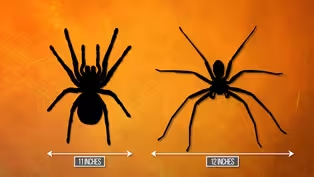
What is the biggest spider in the world?
Video has Closed Captions
What is the biggest spider in the world? Asks Mia from Massachusetts. (1m 28s)
Video has Closed Captions
Do all jellyfish sting? Asks Clinton from California. (1m 51s)

Why do dolphins jump in the air?
Video has Closed Captions
Why do dolphins jump in the air? Asks Nancy from England. (1m 48s)
Providing Support for PBS.org
Learn Moreabout PBS online sponsorshipThis is a house... and a skeleton.
But you probably know it as a snail shell.
Snails are actually born with their shells when teeny tiny snails hatch out of their eggs, they already have a shell around their soft body parts, but the early shell is soft and transparent.
Some snails eat their egg shells after they hatch to start the process of getting calcium, a mineral they need to harden that shell and help build new sections.
as they get bigger.
Calcium is important to our bodies too.
It helps us have strong bones and teeth, and the shell of a snail is like a skeleton on the outside, called an exoskeleton that helps protect their squishy bits.
As they grow, snails will build on to their shells, adding layers of calcium carbonate to the opening so it gets bigger and wider.
Some snails continue to grow their shells for their whole lives, while others have a kind of adult point where they basically stop growing.
Did you know that almost all snail shells curve or whirl clockwise?
Follow the coil of the smallest part as it widens out, and it will follow the direction of the hands on a clock.
Very occasionally you'll find a snail that was left handed or more appropriately, left footed.
Since snails are part of the gastropod family, a word that literally means stomach, foot.
Some other animals build their own shells too, like oysters, clams, and mussels.
Snails keep their shells for their whole lives, but after the snail is gone, sometimes its shell provides a home for an animal that doesn't grow its own: A hermit crab!
Hermit crabs take discarded snail shells to protect themselves, and often have to find a new one when the one they have starts to feel crowded.
And try this on for size.
If you really like shells, maybe you'll become a conchologist.
That's someone who studies them.
To make sure you never miss.
But why?
Like this video and subscribe to our channel and find out more about why kids.org.

- Science and Nature

Explore scientific discoveries on television's most acclaimed science documentary series.

- Science and Nature

Capturing the splendor of the natural world, from the African plains to the Antarctic ice.











Support for PBS provided by:
But Why – A show for curious kids is a local public television program presented by Vermont Public