Prairie Sportsman
Pristine to Green
Clip: Season 17 Episode 13 | 15m 34sVideo has Closed Captions
Bret Amundson looks back at a decade of sharing the best of Minnesota’s outdoors.
Bret Amundson looks back at a decade of sharing the best of Minnesota’s outdoors as the host of Prairie Sportsman. Over the years Bret has taken viewers on fantastic fishing trips, epic hunts, and has highlighted the important research and conservation efforts that make our enjoyment of the outdoors possible.
Problems playing video? | Closed Captioning Feedback
Problems playing video? | Closed Captioning Feedback
Prairie Sportsman is a local public television program presented by Pioneer PBS
Production sponsorship is provided by funding from the Environment and Natural Resources Trust Fund and Shalom Hill Farm. Additional funding provided by Big Stone County, Yellow Medicine County, Lac qui...
Support provided by:


Prairie Sportsman
Pristine to Green
Clip: Season 17 Episode 13 | 15m 34sVideo has Closed Captions
Bret Amundson looks back at a decade of sharing the best of Minnesota’s outdoors as the host of Prairie Sportsman. Over the years Bret has taken viewers on fantastic fishing trips, epic hunts, and has highlighted the important research and conservation efforts that make our enjoyment of the outdoors possible.
Problems playing video? | Closed Captioning Feedback
Where to Watch Prairie Sportsman
Prairie Sportsman is available to stream on pbs.org and the PBS app.
Providing Support for PBS.org
Learn Moreabout PBS online sponsorship(mysterious music) Something strange is happening in Minnesota's remote Northern Lakes, and we don't know why.
Scientists from the St.
Croix Watershed Research Station are on the case.
- Lakes in northern Minnesota are valued across the state for their high water quality and for the incredible recreational opportunities they afford Minnesotans.
But recently, reports of cyanobacterial blooms have been rising in these lakes, and we are investigating why that might be happening in places where we least expect them.
Cyanobacterial blooms tend to look like thick green paint has been smeared across the surface.
They tend to be shiny.
They are blue green, hence their name cyanobacteria.
- [Scientist] That might be the most blue green.
- And the toxins that are produced pose a significant public health risk to people who might be recreating in the Boundary Waters or the Superior National Forest - [Bret] With potential public health risks looming on the horizon, can researchers discover why these Northern Lakes are going from pristine to green?
(dramatic music) - So here at the St.
Croix Watershed Research Station, we specialize in the study of lake water quality and the history of lake ecosystems.
So this project is focused on how and why we might be seeing a change in some of our most pristine lakes.
(slide projector whirring) (slide changer clicking) So there have been anecdotes of lakes in the Boundary Waters and within the Superior National Forest that are more naturally productive.
So people have been observing greenness in these lakes for many decades.
I think the concern now is that the algal community may have shifted from algae that are green and are blooming, but now they're becoming the type of algae that can produce toxins and have more negative ecosystem implications.
And cyanobacteria are the group of algae that we're most concerned about.
And they've been around for millions of years.
They are responsible for the changes in the Earth's atmosphere that resulted in life as we know it.
And so they are a important part of any aquatic ecosystem.
The issue with cyanobacterial blooms is when they bloom in excess of all these other algae.
And so the balance is thrown off in the ecosystem.
And so our work is hoping to identify whether these shifts truly have occurred and if there is more of a threat for toxins being produced in these lakes into the future.
- [Bret] While toxins from cyanobacteria are a concern, these troublesome organisms have found an admirer in the research team's microbiologist, Hailey Sauer.
- Yeah, turning around.
I'm such a fan of cyanobacteria, because they are the ultimate competitor.
They are the New York Yankees (baseball organ music) of the water column.
So cyanobacteria can store phosphorus in their cells.
They don't need it right now, but they might need it later.
And so it makes them competitive.
They've evolved to become buoyant so they can go up into the sunlight, do their photosynthesis.
Night comes around, they'll sink down in the water column where all those nutrients are, grab them and then float back up.
And then they can just kill their competitors through the use of these toxins.
They're not doing it because they wanna hurt the water.
They just wanna do it so that they can live there and no one else can.
(gentle music) - [Bret] A large part of the success of this bacterial dynasty is the organism's ability to compete for phosphorus, a critical nutrient for life.
- Phosphorus is part of our biological structures, so it's part of our cell walls and it's part of our DNA.
It's also a really important part of the machinery that produces energy for all of us to live our lives.
So it's true for people and it's true for the organisms that we're concerned about in this project.
We think of phosphorus as what's called a limiting nutrient.
So it is in the least supply relative to demand.
And what that means is that it controls how much growth can happen or how much productivity can happen in a lake.
By adding phosphorus, you're relieving that limiting nutrient and you're allowing much more growth and productivity to happen.
For a long time, people have changed the way that phosphorus moves through environments.
And specifically, we've added a lot of phosphorus.
So runoff from agricultural, industrial, and urban landscapes can be really rich in phosphorus.
And that gets into our waterways and it gets into our lakes, and it can fuel algal growth.
What's curious about these pristine lakes is that their watersheds haven't been developed.
And so it's this puzzle as to, like, why are we seeing the kinds of increases in potential productivity, more algal growth, more blooms that we see typically in other parts of the state that are more developed.
- [Bret] Researchers begin to tackle this puzzle during an initial phase in 2022, and they had a suspect in mind.
- Our initial hypothesis was that dust coming from far away was depositing in these lakes, bringing in nutrients.
and stimulating algal blooms.
But ultimately what we found was that the amount of dust that was coming in was not a significant contributor to the amount of nutrients that were present in the water column.
And so this indicated that a lot of the nutrients that might be stimulating blooms were coming from the lakes themselves.
♪ Dah-dah.
- [Bret] With distant dust eliminated as a prime suspect, the team began looking for a new culprit.
- So when we're thinking about where phosphorus could be coming from in the lake, we're looking at the sediments or the mud at the bottom of the lake.
And it exists in sediments in a number of different forms.
But the form that lake scientists and managers think a lot about is phosphorus bound to iron.
So iron is able to bind with phosphorus in the water column, and it sinks to the bottom into the mud.
And it can hold it there, which means that that phosphorus is no longer available to be taken up by algae and cyanobacteria.
But that iron can only hold phosphorus in the presence of oxygen.
And without oxygen, the iron will be reduced and solubilize, and it releases that phosphorus back into the environment.
So oxygen is a critical piece of whether or not sediments can hold on to their phosphorus.
- [Bret] And the amount of oxygen in a lake can be impacted by water temperature, specifically by a phenomenon known as lake stratification.
- As someone who recreates on a lake, you might be familiar with the fact that the top layer of a lake tends to be much warmer than the bottom.
So if you're swimming or paddling on a lake, you're on the the warm layer.
But if you swim down into to a deeper layer, you can feel around you that the water is getting colder.
And this difference in temperature is actually also reflective of difference in water density, so how thick the water might be.
So colder water is denser, and that's why it's on the bottom.
And this difference in density also creates this physical barrier between the colder bottom layers of a lake and the warmer upper layers of a lake.
So now that it's disconnected from the atmosphere, there are other biological processes in the sediments that consume oxygen.
And so the bottom waters experience anoxia, a loss of oxygen.
- And when that happens, you get these pulses of phosphorus out of the sediment.
- [Bret] For a while, the phosphorus emitted from the lake bed will be trapped in the colder bottom layer of the lake.
But as the lake temperature equalizes, the lake will mix, and nutrients from the bottom will be freed to the surface waters where they'll be used by algae and cyanobacteria.
While this mixing is common in many lakes, it was not expected in the lakes the research team was studying, - We've presumed that many of these lakes wouldn't mix at all, that they would be the same temperature throughout, that their bottoms would never be different from their tops, because the lake isn't thought to be deep enough to be forming these layers.
But what we were finding is that they actually were stratifying and mixing intermittently and somewhat unpredictably throughout the summer period.
And so in these conditions, we're actually finding that that sediments and nutrients are being stirred up into the water column multiple times throughout the summer and essentially pulsing nutrients pretty frequently for algal growth and productivity.
- [Bret] With this updated evidence, researchers now had a new suspect for the increase in toxic blooms in Minnesota's pristine waters.
- Our hypothesis is that climate change is a major culprit for warming lakes and stimulating the stratification anoxia process.
We're seeing a difference in the way lakes respond.
So their tops are actually warming faster than their bottoms.
And so this is increasing the strength of the stratification that we're seeing in lakes.
And so in lakes that used to be well mixed throughout their entire water column are now starting to experience periods of stratification and anoxia - [Bret] To help test their theory, the investigative team is gathering more data to improve their understanding of these Northern Lakes.
- So what we've done is we've taken sediment from the bottom of each of our study lakes, and we've exposed them to two experimental treatments: one in which the sediment is exposed to oxygen and one where they have no oxygen availability.
And so we're testing how much nutrients are coming out under each of these two conditions.
And so if we know that a lake has experienced so many days of anoxic conditions, we can then calculate how much nutrients we would expect to be coming out of those sediments and understand whether the nutrients that we're seeing in the water column that are simulating these blooms can be directly attributed to the nutrients or if there's another culprit involved.
- [Bret] As part of their investigation, the team utilizes the research station's lab, which can essentially look back in time, an important capability when researching something as fleeting as cyanobacteria blooms.
(upbeat music) - It's easy to see cyanobacteria when they're in the bloom, but then it's a windy day and the lake water moves around, and all of a sudden they're gone.
So what's left to know that they were there?
Well, they died, potentially.
They don't have a really long life cycle.
So they die and then they sink to the bottom.
Just like everything sort of is slowly sinking to the bottom of a lake, so are these cyanobacteria that were once on the surface.
- So basically what happens is, over time, material from both within a lake and from the surrounding environment accumulate on the lake bottom, and they form layers of sediment.
And so what you can do is if you collect a sediment core, you can basically use those layers of mud or sediment to be able to reconstruct what was happening in the lake and the surrounding environment.
- And when we those sediment cores, we can take bits of them, extract DNA, and get a sense for what organisms were maybe around during a time when this mud settled to the sediment.
- [Bret] Not only can researchers see what was there, but also what they were doing.
- We can go in very targetedly, and we can say, "I wanna know which ones of these organisms are producing the liver toxin."
And so I can just say, "I wanna look at all of the DNA I have, tell me how many copies of that gene that I have."
And that gives me a sense for how much of the population might be producing that toxin.
- [Bret] Although the team is still in the early stages of their research, a picture of these Northern Lakes is beginning to emerge.
- They're trending in this direction that would suggest that they're going to become better hosts for toxic cyanobacteria.
But it's not like these lakes have have swung and become entirely new ecosystems.
I think there's a lot of hope for maintaining the pristine quality of our most prized lakes in Northern Minnesota.
- [Bret] And the work of maintaining the quality of these lakes has benefited from collaboration.
- So when we started this project just this last year through the help of the Environment and Natural Resources Trust Fund, we partnered with 1854 Treaty Authority and the Red Lake DNR, which are two tribally-led resource management entities in Northern Minnesota.
And so we're expanding the number of lakes that we're monitoring over the next three years.
And we're also trying to address questions that are related specifically to tribal concerns.
For example, how do cyanotoxins affect wild rice growth?
How might it affect different kinds of recreation or ceremonial uses that communities have around different lakes that are experiencing blooms?
And so I think that our partnerships with these organizations are not only advancing our scientific goals, but they're advancing our desire to address the more socially impactful questions.
- [Bret] While these lakes are experiencing uncertain times, their place in the hearts of Minnesotans remains a constant.
- The Boundary Waters and the Superior National Forest are a state treasure.
There are so many Minnesotans that have really amazing memories of recreating in the boundary waters.
And so preserving that water quality and those experiences for future generations is really important to our identity as Minnesotans.
(gentle music)
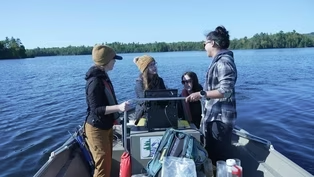
A Decade of Minnesota and Pristine Green
Video has Closed Captions
Preview: S17 Ep13 | 30s | Host Bret Amundson reflects on 10 years of hosting and researchers investigate cyanobacteria blooms. (30s)
Video has Closed Captions
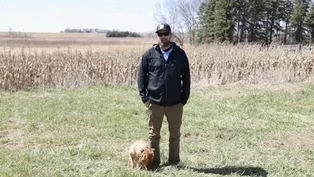
Clip: S17 Ep13 | 9m 54s | Bret Amundson looks back at a decade of sharing the best of Minnesota’s outdoors as the host. (9m 54s)
Providing Support for PBS.org
Learn Moreabout PBS online sponsorship New Episode
- Science and Nature

Explore scientific discoveries on television's most acclaimed science documentary series.





 New Season



 New Season


Support for PBS provided by:
Prairie Sportsman is a local public television program presented by Pioneer PBS
Production sponsorship is provided by funding from the Environment and Natural Resources Trust Fund and Shalom Hill Farm. Additional funding provided by Big Stone County, Yellow Medicine County, Lac qui...