
A City in Nature | WILD HOPE
Special | 14m 51sVideo has Closed Captions
How does a densely populated nation like Singapore transform into a lush green oasis?
How does a densely populated, skyscraper-lined nation like Singapore transform into a lush green oasis where wildlife thrives alongside humans? The island nation’s ambitious vision of becoming a “City in Nature” aims to integrate urban living with biodiversity and requires careful coordination between government leaders, designers of the urban landscape, and its citizens.
Problems playing video? | Closed Captioning Feedback
Problems playing video? | Closed Captioning Feedback
Major support for NATURE is provided by The Arnhold Family in memory of Henry and Clarisse Arnhold, Sue and Edgar Wachenheim III, The Fairweather Foundation, Charles Rosenblum, Kathy Chiao and...
A City in Nature | WILD HOPE
Special | 14m 51sVideo has Closed Captions
How does a densely populated, skyscraper-lined nation like Singapore transform into a lush green oasis where wildlife thrives alongside humans? The island nation’s ambitious vision of becoming a “City in Nature” aims to integrate urban living with biodiversity and requires careful coordination between government leaders, designers of the urban landscape, and its citizens.
Problems playing video? | Closed Captioning Feedback
How to Watch Nature
Nature is available to stream on pbs.org and the free PBS App, available on iPhone, Apple TV, Android TV, Android smartphones, Amazon Fire TV, Amazon Fire Tablet, Roku, Samsung Smart TV, and Vizio.
Buy Now
Explore More Ways to Watch
Bring the beauty and wonders of wildlife and natural history into your home with classic NATURE episodes.Providing Support for PBS.org
Learn Moreabout PBS online sponsorshipMore from This Collection
WILD HOPE is a new series of short films that highlights the intrepid changemakers who are restoring our wild places and sparking new hope for the future of our planet.
Video has Closed Captions
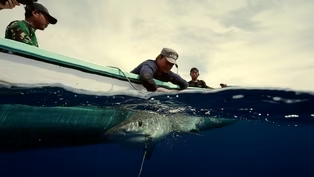
An unlikely partnership in East Lombok turns shark hunting into a ecotourism venture. (15m 35s)
Video has Closed Captions
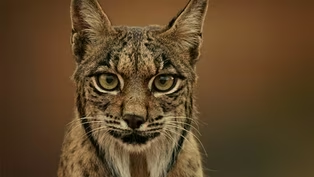
Once on the brink of extinction, the Iberian lynx has been given a chance to thrive again. (17m 23s)
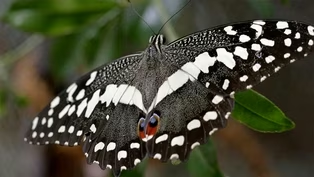
The Butterfly Effect | WILD HOPE
Video has Closed Captions
To help stop the rise of deforestation in Zanzibar, one village has begun to farm butterflies. (12m 24s)
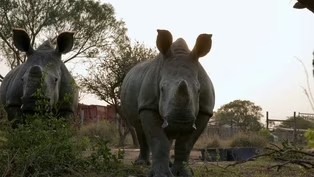
Video has Closed Captions
For decades, rhinos have been the face of poaching. (16m 28s)
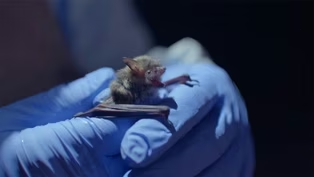
Video has Closed Captions
As a deadly fungus devastates North America’s bats, scientists are testing new ways to save them. (14m 47s)
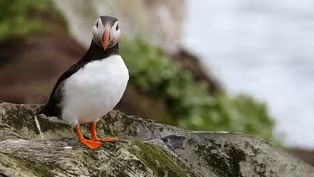
Video has Closed Captions
In the Westman Islands, one community has banded together to save lost young puffins. (13m 15s)
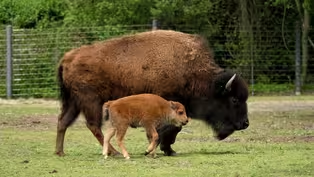
Video has Closed Captions
Sixty million American bison once thundered across the prairies of North America. (18m 52s)
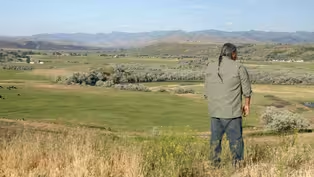
Reclaiming Bear River | WILD HOPE
Video has Closed Captions
The Bear River was once a lush area with wetlands, hot springs, and abundant wildlife. (17m 25s)
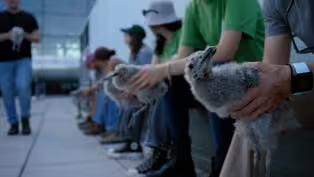
Building for Birds | WILD HOPE
Video has Closed Captions
Millions of migrating birds pass through our yards, but glass windows pose a deadly threat. (16m 3s)

Mission Impossible | WILD HOPE
Video has Closed Captions
Meet the genius behind the plant-based Impossible Burger. (39m 41s)
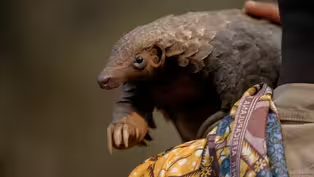
Pangolin Protectors | WILD HOPE
Video has Closed Captions
Due to the demand for their scales, pangolins are the most trafficked animal in the world. (12m 24s)
Providing Support for PBS.org
Learn Moreabout PBS online sponsorshipWe continue to discover new things even on this little island in Singapore.
There is no formula to it.
You never negotiate with mother nature.
But not all human-nature interfaces end up happy.
We have literally removed their homes and created ours.
Today we are doing the opposite.
Now you see a thriving city in nature.
The saying is of course you cannot protect what you do not love.
You cannot love what you do not understand.
You cannot understand what you are not taught.
So we are starting from the ground up.
Singapore is amongst all other cities in the world, one where you can find critically endangered animals living next to people.
Because we created a home for them.
Singapore was developing its own brand of greenery.
Because of our Garden City concept, many of our projects required greenery to be incorporated as part of the building site.
If you go down to downtown Singapore there are still buildings of concrete glass and steel, they're very functional.
They're not necessarily environmentally friendly.
Greenery is just a decoration, an embellishment after the building has been designed.
We started looking at vertical greenery.
If you go into a forest, what are the kinds of vines that grow up?
And we try to replicate that through biomimicry in buildings.
You walk into a hospital, you don't get the hospital antiseptic smell.
The flora and fauna were selected based on native species that attract birds, dragonflies, butterflies.
Over time, the different critters came to appreciate what the flora can do for them.
And they started visiting this environment.
We had a pangolin in 2017.
The otters came in like a family of 10 but they wiped out all our fish.
When we first started, there were only three butterfly species found.
Today the most recent count was 114 species.
We have discovered about 36 species of dragonflies.
The number of species of birds is 96 and increasing.
They are important as an indicator of the health of the environment.
People heal faster in a green environment.
The ability to look out the window, see greenery, finding peace as they heal.
Like going for a holiday, instead of coming to a hospital.
Many of the people who come to the hospital are not patients, and they are people who actually come with cameras like butterfly enthusiasts or bird people.
This is about introducing nature back to Singapore.
The things that we have lost in those years of industrialization and rapid development.
We continue to evolve into a city in nature.
Right in front of you.
Do you see it?
In front of you.
Oh my God.
It's staring right at me.
Right?
Get the front shot.
I think that'll be nice.
Got it.
Got it too.
I have around 80 to 82?
And I'm currently at 91.
I'm catching up.
It gets harder.
As you can see, we are in a huge green space smack in the middle of apartment blocks full of people roads, construction all around.
And it just shows how nature can be integrated into our infrastructure and growth.
They are so cute.
Oh, look at that.
let alone insects.
We are literally coexisting right beside otters, monitor lizards, birds.
And I believe that's great.
Initially we were considered the emotional tree huggers.
People don't understand why we love nature so much.
But when we started interacting with young students, there was a cause that they were fighting for, you know, and nature was their cause.
Because this is their future.
There at the edge.
Oh, I see.
Oh yes, yes, yes.
Okay.
We are strapped for land.
The lack of resources actually makes an architect more creative.
This is what energizes me to carry on with my green movements studying butterflies because knowledge never stops.
Whether it's of the biodiverse environment or the built environment.

- Science and Nature

Explore scientific discoveries on television's most acclaimed science documentary series.










Support for PBS provided by:
Major support for NATURE is provided by The Arnhold Family in memory of Henry and Clarisse Arnhold, Sue and Edgar Wachenheim III, The Fairweather Foundation, Charles Rosenblum, Kathy Chiao and...