
Birds of Prey: World Center for Birds of Prey
Special | 6m 8sVideo has Closed Captions
Visit the World Center for Birds of Prey.
Researchers are trying to find ways to save a number of birds of prey from extinction. Visit the World Center for Birds of Prey and see what scientists are doing and learn what you can do to save these amazing birds.
Problems playing video? | Closed Captioning Feedback
Problems playing video? | Closed Captioning Feedback
Science Trek is a local public television program presented by IdahoPTV
Major Funding by the Laura Moore Cunningham Foundation and the Idaho National Laboratory. Additional Funding by the Friends of Idaho Public Television and the Corporation for Public Broadcasting.
Birds of Prey: World Center for Birds of Prey
Special | 6m 8sVideo has Closed Captions
Researchers are trying to find ways to save a number of birds of prey from extinction. Visit the World Center for Birds of Prey and see what scientists are doing and learn what you can do to save these amazing birds.
Problems playing video? | Closed Captioning Feedback
How to Watch Science Trek
Science Trek is available to stream on pbs.org and the free PBS App, available on iPhone, Apple TV, Android TV, Android smartphones, Amazon Fire TV, Amazon Fire Tablet, Roku, Samsung Smart TV, and Vizio.
Science Trek
Science Trek is a place where parents, kids, and educators can watch short, educational videos on a variety of science topics. Every Monday Science Trek releases a new video that introduces children to math, science, technology, engineering, and math (STEM) career potentials in a fun, informative way.More from This Collection
Every animal in an ecosystem plays an important role in the well-being of our planet. Some are predators. Some are prey. Some pollinate plants or spread seeds. Each contributes to its part of the community and land around it. Take time to learn more about the lives of animals.

Yellowstone: A Most Unusual Neighborhood
Video has Closed Captions
Yellowstone National Park is unlike anywhere else on Earth. (8m 14s)
Video has Closed Captions
What special skills do birds of prey have that make them such good hunters? (6m 52s)
Video has Closed Captions
Learn what bears like to eat and why you should avoid them. (6m 49s)
Bears: Grizzly, the Bear in a Coat
Video has Closed Captions
How are grizzly bears different from other bears? (5m 33s)

Video has Closed Captions
Architects borrow from nature all the time. Find out how. (6m 26s)
Rabbits: Are You Rabbit Ready?
Video has Closed Captions
What do you need to know before getting a rabbit for a pet. (5m 57s)
Video has Closed Captions
Showing rabbits at your local fair opens the door to science. (6m 30s)
Video has Closed Captions
What is White Nose Syndrome and why is it so deadly? (5m 15s)
Video has Closed Captions
How do bats find their food at night? (4m 17s)
Video has Closed Captions
Why do snakes always look like they are staring? (3m 43s)
Providing Support for PBS.org
Learn Moreabout PBS online sponsorshipJOAN CARTAN-HANSEN, HOST: What does it take to be a bird of prey?
What are researchers doing to protect these disappearing animals?
Learn what you can do to make a difference.
Let's go to the World Center for Birds of Prey.
[MUSIC] CARTAN-HANSEN: In the Idaho desert, just outside of Boise, is the World Center for Birds of Prey supported by the Peregrine Fund.
STEPHANIE ASHLEY, CURATOR OF BIRDS: We have scientists who work all over the world who are trying to study birds of prey, figure out what they need to survive, and then people can come here to Boise, to our interpretive center and learn about them.
CARTAN-HANSEN: Here, birds of prey, like Griffin, a female Swainson's hawk, show off for visitors.
These programs do more than just let you see a bird or prey up close.
ASHLEY: They can come to our programs; they can come and see our exhibits.
They can learn about the work that we do, and hopefully when they leave, they feel like they want to help protect these birds because a lot of them are endangered.
And most of the time it's because of people.
And so, the idea is if people care about them, then we take better care of them.
We have them around for a long time to come.
JADN SOPER, RAPTOR SPECIALIST: So we here in Southwest Idaho, live in a really, really cool spot where we actually have one of the largest densities of nesting raptors in the world.
And so, because of that, we here at the World Center for Birds of Prey, our job is to help inspire people to love birds of prey, because in the conservation world, you can't protect something if you don't love it.
CARTAN-HANSEN: You might think birds of prey aren't in your community.
ASHLEY: You may not have a Peregrine Falcon in your backyard, but I can almost guarantee that you have a Red Tail Hawk or you have a Great Horned Owl, or you have an American Kestrel, or you have all different kinds of stuff here in the Western United States.
So, if you love birds of prey, you can protect your own backyard raptors.
And the more people around the world protecting their backyard raptors, the less declines we have.
CARTAN-HANSEN: And why would you want birds of prey in your neighborhood?
ASHLEY: They have a cultural significance, and that is significant.
You know, if you think about a world without birds of prey in it, that's pretty sad.
So right off the bat, they're beautiful and they're worth having around just because of that.
But beyond that, they have a really important role in the ecosystem.
And that role is really broad depending on which species you're looking at and which ecosystem you're looking at.
So, if you're looking at a bird like Griffin, here she is pest control, right?
Who's going to eat those insects and who's going to eat those rodents and those snakes?
It's our birds of prey who are doing it.
We call them regulators in ecosystems because they're regulating and helping to keep everything in balance.
CARTAN-HANSEN: And what happens if birds of prey disappear?
ASHLEY: There's more mice, there's less plants, there's more invasive plants.
We lose a lot of biodiversity when we lose our, our top-level predators.
And then we have birds like vultures that are cleaning things up.
And so, if you don't have scavengers out there that are eating all those dead things, you can spread diseases a lot more, and everybody gets a little sicker.
And we've seen that happen in other parts of the world where there's been big losses of vultures and everybody is getting sick because diseases are getting spread more easily.
CARTAN-HANSEN: There are things that you can do to help protect raptors in your area.
SOPER: Peregrine falcons, they're primarily eating other birds.
A lot of birds are eating bugs.
And so, one of the best things we can do to help protect our own backyard raptors is just limit our use of poisons around the house.
Your backyard Screech owl is probably going to be eating a lot of mice.
You can use non-poisonous forms of rodent control, or if you've got a lot of insects around, instead of spraying pesticides, you can use non-poisonous forms of insect control, or even nonpoisonous forms of weed control and unwanted plants, anything like that.
That's a great way to help your backyard raptors.
If you've got stable dead trees, you can actually let them stand because a lot of our backyard raptors are actually cavity nesters.
They like to find a little cavity in a tree and they like to nest in there.
So, if that tree is not going to fall over and it's stable to let stand, you can let it stand and those backyard birds will have a place to live.
CARTAN-HANSEN: The birds of prey are in danger due to habitat loss, something the Peregrine Fund is trying to change.
The World Center for Birds of Prey is home to 22 birds, all of which cannot be released for one reason or another.
They're used as education ambassadors.
One of those is Schmidt, a Peregrin Cassini falcon.
"Come on buddy.
Good boy."
SOPER: His job gets be to educate people because you can get up close and personal with Schmidt.
You can see his amazing little face.
You can watch him fly around and you can really fall in love with him in a way that's kind of hard to do a mile away from a wild bird.
"Good job!"
[FALCON SCREECHES] SOPER: Not every bird that gets injured should be in an education ambassador.
We work very hard to find birds that are very, very good at this job and very comfortable doing it.
So, any of these free flighted programs we can do, anytime we are going to schools and visiting with our birds, we're getting as many people to fall in love with them.
And so, we're hopefully protecting birds of prey around the world through that.
CARTAN-HANSEN: There is more we all can do to help birds of prey.
Find out about these amazing animals and share your knowledge with others.
Maybe even consider becoming a scientist who studies birds of prey.
And help the people at the World Center for Birds of Prey so we all can enjoy the sight of birds of prey soaring in our backyards.
If you want to learn more about Birds of Prey, check out the Science Trek website.
You'll find it at ScienceTrek.org.
[MUSIC] ANNOUNCER: Presentation of Science Trek on Idaho Public Television is made possible through the generous support of the Laura Moore Cunningham Foundation, committed to fulfilling the Moore and Bettis family legacy of building the great state of Idaho, by the Idaho National Laboratory, mentoring talent and finding solutions for energy and security challenges, by the Friends of Idaho Public Television, and by the Corporation for Public Broadcasting.
Birds of Prey: Necks, Eyeballs, and Crops
Video has Closed Captions
Clip: Special | 1m 4s | How do owls seem to turn their head 360 degrees? (1m 4s)
Video has Closed Captions
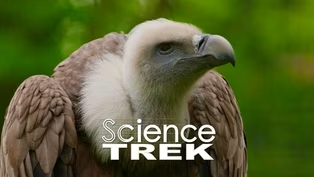
Clip: Special | 1m 4s | Why is eating up dead carcasses good for the environment? (1m 4s)
Providing Support for PBS.org
Learn Moreabout PBS online sponsorship
- Science and Nature

Explore scientific discoveries on television's most acclaimed science documentary series.

- Science and Nature

Capturing the splendor of the natural world, from the African plains to the Antarctic ice.










Support for PBS provided by:
Science Trek is a local public television program presented by IdahoPTV
Major Funding by the Laura Moore Cunningham Foundation and the Idaho National Laboratory. Additional Funding by the Friends of Idaho Public Television and the Corporation for Public Broadcasting.